How Opendoor is rebuilding its product culture with Linear

Kaz Nejatian, the new CEO of Opendoor, was in the middle of a very public turnaround. Investors were watching, and there was a long list of things to fix. And yet, one of his first moves was to change the project management software his team was using to build Opendoor’s product.
Lessons from Shopify
Fahd Ananta joined Opendoor the day after Kaz. They had both worked at Shopify for years, and Shopify had shaped how both of them thought about building products.
Shopify had an internal tool called Vault that gave leadership a clear view of what every team was working on at any given moment. Tobi Lütke had invested early in building it because he understood that if you can’t see what’s happening, you can’t course correct. Vault made work legible across the entire company. Once you’ve operated that way, you can’t unsee it.
Opendoor had Jira, but no one used it the same way
Opendoor used Jira, but each team used it differently. There was no consistency or shared structure, and no clear sense of who owned what outcomes.
There was a moment early on when leadership asked a simple question about what the product teams were working on. Some teams pointed to Jira boards that were not kept up-to-date, while others started pulling together spreadsheets on the spot. Fahd and Kaz looked at each other. They’d seen this movie before and they knew what to do.
At Shopify they would have turned to Vault. But Vault had taken years to build with a dedicated engineering team maintaining it full time. Fahd and Kaz considered whether they’d need to build something similar from scratch.
A manifesto for building products
Before looking at any tools, Fahd sat down and wrote a document called “Building Products at Opendoor.” The doc described the world they wanted to live in and offered a framework for getting there.
A few principles anchored the whole thing:
- Every project would have a directly responsible individual (DRI) so that ownership was never ambiguous
- Teams would be organized around product areas rather than reporting lines
- Work would move through a clear set of phases, including one called “Launch & Refine” that existed because they had seen too many projects ship and then disappear. Launching is just a moment in time. Teams were expected to keep watching the metrics and keep iterating until the work was either successful or explicitly killed
- And every week, each project lead would post an update so that progress was visible to the entire company
Fahd spent a weekend configuring Linear and found that everything he had written down was possible to model without writing any custom code. What Shopify had a dedicated team to build and maintain, Opendoor could get 90% there with one person over a weekend, using software that already existed.
He spent two days meeting with every engineering lead and product manager at the company, walking them through the system and getting them set up.
We’ve effectively built our own version of Shopify’s Vault using Linear.
Making work legible at Opendoor
With Linear configured and the team onboarded, the principles started to take shape. The weekly updates are a good example of how this played out. Every Friday, project leads share progress on their work. Those updates automatically stream into a Slack channel the whole company can see, and every Monday an automation pulls the highlights together and shares them with everyone.
People outside of engineering started noticing. They said it felt like Opendoor went from shipping one product a quarter to constantly seeing new things tested and launched. Some of that was real because the pace did increase and some was simply that the work was now visible. It had always been happening. Now everyone could see it.
The side effect was surprisingly cultural. When your progress is on display next to everyone else’s, it creates a kind of positive competition. Teams saw others doing it, wanted to contribute their own, and it drove momentum. Not through mandates or management pressure, but through the simple fact of transparency.
Tools shape how you work
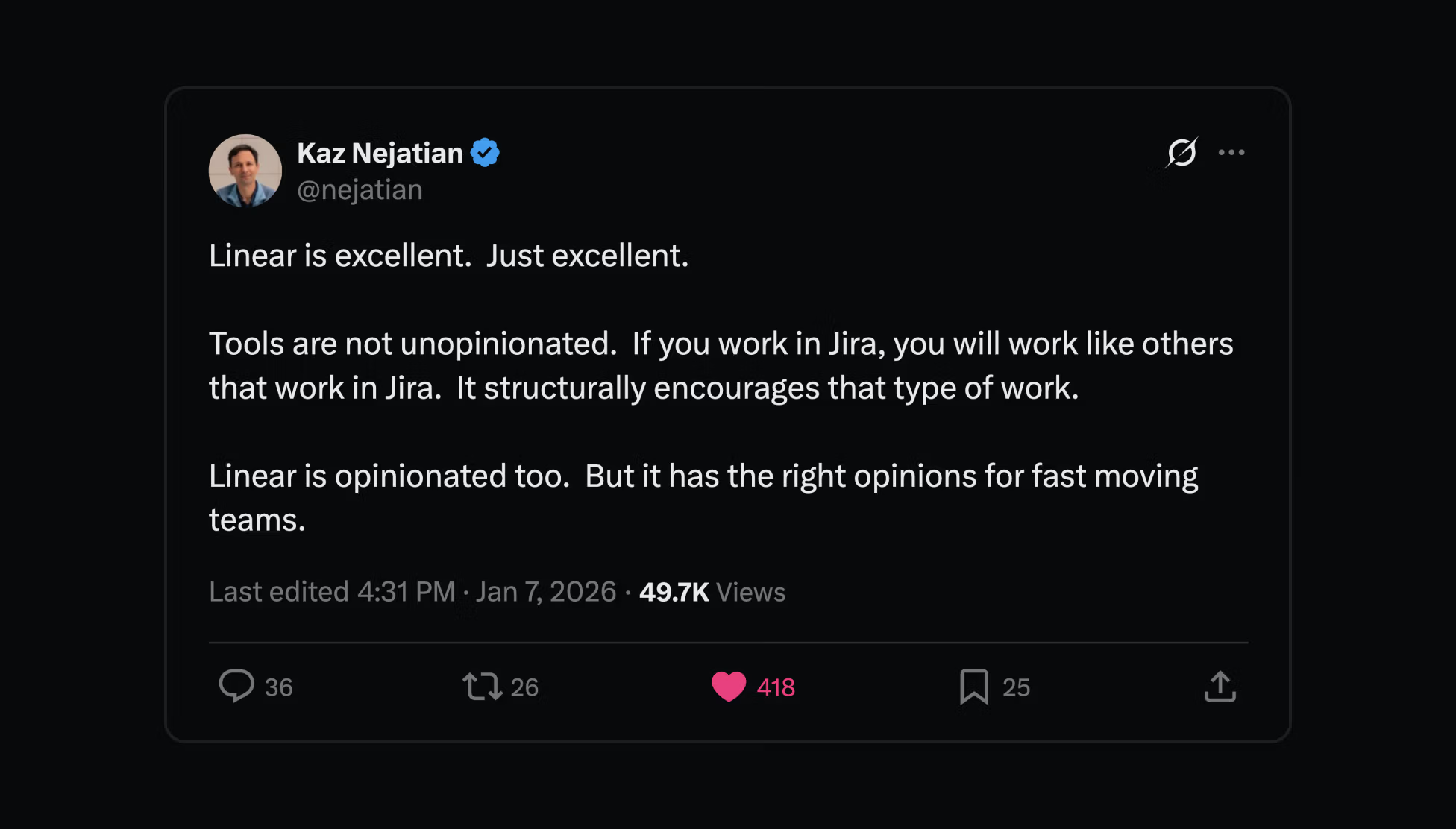
Kaz posted that a few weeks after the switch. There’s an idea, often attributed to Marshall McLuhan but actually written by his friend John Culkin, that “we shape our tools and thereafter our tools shape us.” Kaz understood this. Tools are not neutral. They have opinions about how work should happen, and the software you live in every day shapes how you actually work.
Opendoor chose to start fresh
When teams switch to Linear, they tend to approach migration differently. Some run a two-way sync between Linear and their old tool. Others do a full migration, bringing everything across. And some simply switch without bringing any of their old work with them. They see it as a clean slate.
Opendoor chose the clean slate. It’s hard to rebuild a company while holding onto the systems that defined its old way of working.
We are building Opendoor right in the open. We want our teams to know exactly what is happening and where we are going. So we can help each other and hold each other accountable. Linear gives us every tool we need to do just that.